Conservation, Memory, Innovation and Social Value
Motril (Granada), 27 September 2025
In Motril (Granada, Spain), at the Sugar Industrial Museum of the Fábrica del Pilar, on the occasion of the 9th TICCIH Spain Congress held in 2025, specialists, researchers, technical professionals, institutions, and representatives of civil society agree to formulate this Charter on Movable Industrial Heritage, with the aim of establishing principles, criteria, and commitments for its recognition, conservation, management, research, and transmission.
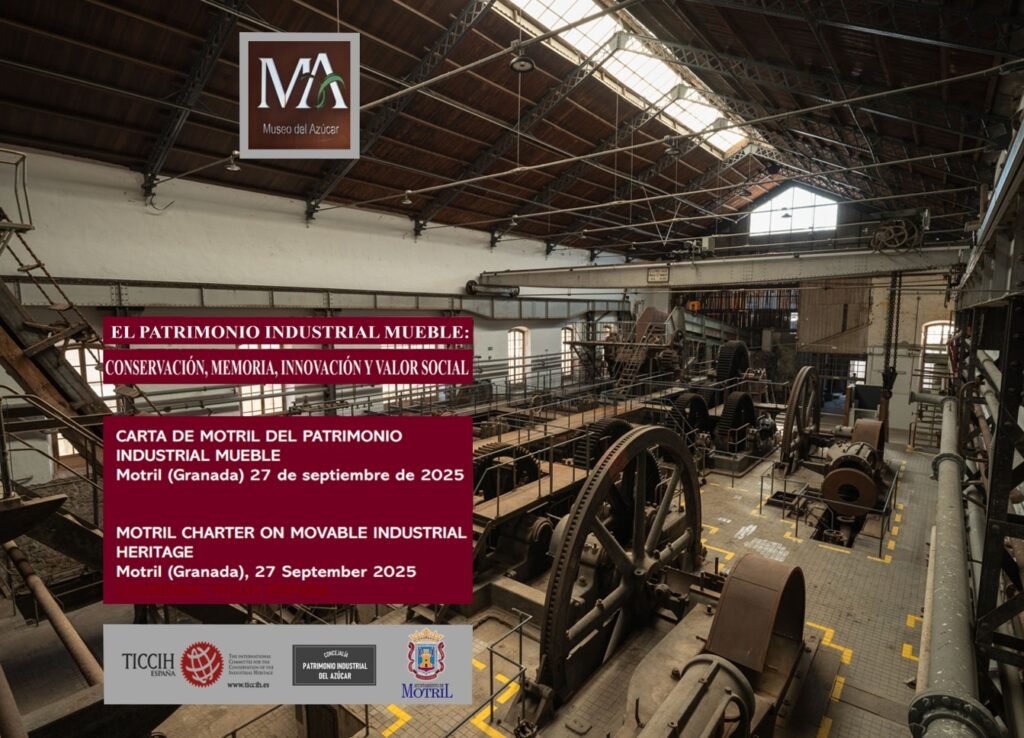
The choice of the former Fábrica de Azúcar del Pilar in Motril as the venue for the 9th TICCIH Spain Congress acquires special significance in this context. The technological uniqueness of its machinery—including mill trains, boilers, gears, and energy systems, preserved as movable assets in their original location—constitutes a paradigmatic example of the heritage value acquired by industrial objects within their own context.
The preservation of the “place” and its transformation into a Site Museum illustrates how movable industrial heritage, in dialogue with architecture and the productive landscape, becomes a fundamental resource for collective memory and for contemporary processes of cultural revitalisation, with a particularly significant impact at the local level.
Movable industrial heritage constitutes an essential part of the historical, technological, social, and cultural memory of industrial societies. Its safeguarding is indispensable to guarantee the continuity of the values associated with the culture of work and technical innovation. Movable industrial heritage (machinery and tools) is the essential link: it is the element that materialises knowledge (trades, processes, and procedures) within physical, immovable spaces (factories, workshops, dwellings, and landscapes), giving them concrete meaning.
Movable industrial heritage comprises machines, tools, furniture, rolling stock, prototypes, designs, instruments, and objects that bear witness to productive processes and to the technical creativity of industrial societies. These assets possess cultural, historical, technological, social, aesthetic, scientific, and symbolic values, and form an inseparable part of industrial heritage and, therefore, of the cultural heritage of humanity.
Despite its importance, movable industrial heritage has traditionally occupied a secondary position relative to immovable industrial heritage. The omission of valuation for movable industrial assets once their operational life has ceased is common practice. The original purpose of their existence dictated that they were a means to an end; they are now required to become an end in themselves through necessary preservation. This change of role, which transforms them into transmitters of knowledge, experience, and memory, must be appropriately communicated to society.
This Charter establishes a framework to place them on an equal footing, to integrate them into cultural heritage policies, and to guarantee their transmission to future generations.
Movable industrial heritage frequently faces problems derived from functional obsolescence, such as its physical characteristics of volume, weight, and dimensions, its complex structural configuration, or its articulation into systems and ensembles—factors that make it essential to apply preventative conservation measures rigorously and promptly.
Its safeguarding, preferably in the places where it spent its operational life, is indispensable to guarantee the continuity of the values associated with the culture of work and technical innovation.
The rigorous and systematic identification of movable industrial assets is a fundamental requirement for their conservation and transmission.
1.1. The Autonomous Communities shall promote the preparation of standardised inventories, employing comparable criteria at both national and international levels.
1.2. The creation of open databases that integrate technical, historical, and social information shall be encouraged.
1.3. The cultural value of technical lexicons and workshop vocabularies shall be recognised and incorporated into the documentation.
1.4. Management shall be coordinated through stable public policies, supported by sufficient resources and institutional cooperation.
1.5. During cataloguing processes, testimony from individuals previously linked to the machinery and plant must be included. Their knowledge is essential to activating the network of meanings surrounding the object and its context; this information must be recorded and incorporated into the relevant inventory or database.
Movable industrial assets acquire their full meaning through their relationship with territories, landscapes of production, and the communities that gave rise to them.
2.1. Their recognition as heritage shall integrate the productive context of factories, workshops, and industrialised landscapes, whose material resources, infrastructure, and economic dynamics historically shaped the technical, social, and cultural processes linked to movable industrial assets.
2.2. Curatorial or documentary decontextualisation shall be avoided, ensuring rigorous narratives that restore the historical, social, cultural, and symbolic links between the assets, their productive processes, and the communities that gave them meaning.
2.3. Their integration into local development policies shall be promoted, coordinating heritage, the creative economy, and social participation, while fostering sustainable revitalisation through educational, tourism, and cultural uses that strengthen territorial identity.
2.4. These assets shall be recognised as manifestations of global connections, reflecting the technological exchanges, economic networks, labour mobility, and cultural dialogues that accompanied the historical construction of industrial territories and their productive landscapes.
2.5. Movable assets must be understood as inseparable from the spaces and territories in which they operated, ensuring the preservation of their functional unity and preventing separations that alter their original technical, historical, cultural, and social meanings.
2.6. Territorial contextualisation shall integrate productive landscapes, natural resources, and infrastructure, recognising the ecological interdependencies between territory, industrial activity, and the movable assets that materialise such socio-economic and technological processes.
Movable industrial heritage is inseparably linked to the knowledge and intangible expressions that give it meaning.
3.1. Each object relates to a set of skills, processes, and trades that must be documented in association with the asset; these should be linked to, and included in, its inventory and catalogue.
3.2. Workshop lexicons, colloquialisms, and technical expressions shall be preserved as an integral part of cultural memory.
3.3. The materiality of movable objects, tools, and working utensils shall be preserved as testimony and tangible support for the memory and experience of labour history—including social claims and conflicts—linked to the activities in which they were employed.
3.4. This heritage shall be integrated into the framework of the 2003 UNESCO Convention to guarantee the safeguarding of associated traditional knowledge.
3.5. The recovery of this knowledge shall strengthen cultural continuity between generations.
3.6. The aesthetic and design qualities inherent in movable industrial heritage assets must be considered and preserved for their documentary value, as these items function as the sensory concretisation and enduring material record of the formal narrative associated with the world of work they represent.
The conservation of movable industrial heritage must guarantee its durability, authenticity, integrity, and cultural value, applying criteria of sustainability and social responsibility.
4.1. Preventative conservation strategies shall be promoted, prioritising in situ maintenance over invasive intervention. The periodic operation of movable industrial heritage shall be considered an integral part of preventative conservation.
4.2. For correct intervention, original materials, techniques, and signs of use must be preserved, as well as the patina and the legitimate historical traces of the passage of time. It is also essential to preserve or explain its original location (physical context) and the function for which it was created (cultural meaning).
4.3. Mechanical and functional recovery of the asset shall be encouraged, ensuring that such processes are non-destructive and do not result in a loss of significance.
4.4. The durability of assets shall be understood as a principle of responsible innovation, linking preservation with environmental sustainability.
4.5. The recovery of objects must reinforce heritage resilience, connecting different generations with their industrial history.
4.6. Any intervention should conform to the following criteria:
Movable industrial assets constitute tools for education, social cohesion, and the development of community identity.
5.1. They shall be integrated into various levels of education as instruments for learning and awareness, as they often provide excellent examples of the practical application of fundamental scientific principles.
5.2. These assets preserve the memory of work, including the knowledge and trades that are integral to working-class culture; therefore, their “intangible dimension” must be recovered and preserved.
5.3. Their correct conservation and dissemination strengthen local identity, foster pride in traditional trades, and guarantee the transmission of this legacy to future generations.
5.4. Citizen participation shall be recognised as a necessary condition for the rescue, recovery, and preservation processes.
5.5. Recognising and supporting community groups and voluntary organisations is key: their knowledge and commitment are essential tools for defending and conserving our movable industrial heritage.
Movable industrial assets must be communicated to society through interpretative projects that combine technical rigour with creativity.
6.1. Objects shall be exhibited with historical, technical, and social contextualisation, avoiding their isolation or fragmentation within collections, exhibitions, or locations removed from their context.
6.2. The development of integrated narratives linking technology, work, and everyday life shall be encouraged.
6.3. Museums and interpretation centres are fundamental pedagogical spaces and must maintain cohesive and well-structured collections of scientific and academic rigour.
6.4. Considering the importance of context and the role played by the permanence of functional space in the history of the asset, the creation of “site museums” shall be prioritised, reinforcing local identity and the memory to which their existence contributes.
6.5. Citizen participation in interpretative projects shall be promoted, recognising communities as co-creators of the interpretation and narrative.
Movable industrial heritage bears witness to applied creativity, where utility, technological innovation, and aesthetic value converge.
7.1. Industrial assets shall be analysed as expressions of technological evolution, evidencing technical transformations, process improvements, and the social impacts generated by innovation; they constitute essential records for understanding industrial history.
7.2. The aesthetic dimension of the industrial object shall be recognised, valuing design, proportions, materials, and finishes as fundamental components of its cultural, historical, and technical significance within industrial and productive culture.
7.3. These assets shall form part of the history of industrial design, linking engineering, applied arts, and material culture, and evidencing the creative processes fundamental to understanding modernity, standardisation, and contemporary technological production.
7.4. Research into and dissemination of movable industrial heritage shall be promoted as a source of inspiration for new creative practices, strengthening contemporary innovation through a critical reappraisal of historical technical knowledge and formal languages.
7.5. Industrial assets shall be preserved as technical and material records, containing information on processes, materials, prototypes, patents, and engineering solutions essential for reconstructing technological genealogies and the historical dynamics of industrial innovation.
7.6. Recognition of industrial design as cultural heritage shall be fostered, integrating the analysis of ergonomics, functionality, serialisation, and productive aesthetics to understand its role in everyday life and contemporary culture.
The management of movable industrial heritage must be oriented towards sustainability, innovation, and an intergenerational legacy.
8.1. Its preservation shall contribute to the Sustainable Development Goals (SDGs) and the 2030 Agenda.
8.2. Sustainable management models shall be developed that deliver social, environmental, and cultural benefits for communities.
8.3. The application of new technologies for documentation, restoration, and dissemination shall be encouraged.
8.4. This heritage shall be understood as an active resource for creativity, learning, and social cohesion.
8.5. In addressing the protection of movable industrial heritage, legislation must adopt a bespoke and flexible approach that recognises the particularities of these assets.
This Charter on Movable Industrial Heritage declares that these industrial assets constitute an essential part of the cultural heritage of humanity and require urgent, coordinated action for their preservation.
Calls upon governments, institutions, communities, and international organisations to prioritise movable industrial heritage within cultural policies, recognising its capacity to link memory, identity, and sustainable development.
The 9th TICCIH Spain Congress, held at the Fábrica de Azúcar del Pilar in Motril, reaffirms this commitment, demonstrating how the preservation of original machinery and energy systems from the sugar industry constitutes an inspiring example of safeguarding movable heritage within its territorial context.
The experience gained from this 9th TICCIH Spain Congress at the Sugar Industrial Museum of the Fábrica del Pilar (Motril, Granada) demonstrates that protecting industrial objects is not only a responsibility of stewardship, but also an opportunity for the economic, cultural, educational, and social revitalisation of our communities.